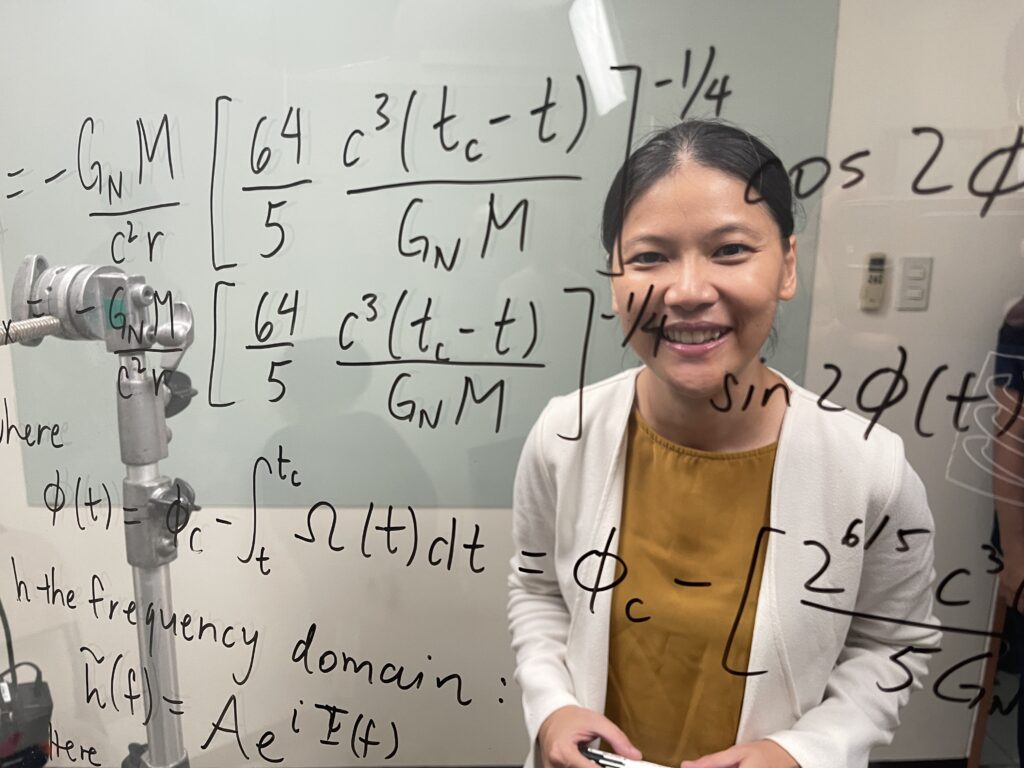
Reinabelle Reyes
Reinabelle Reyes, Ph.D. is an Associate Professor at the National Institute of Physics (NIP) in UP Diliman, where she heads the Data and Computation (D&C) Research Group. She serves as a data science consultant for UNDP Philippines, Z-Lift Solutions, Inc. and Citizen's Budget Tracker. She is also co-founder of Pinoy Scientists and adviser of SEDSPH (Student for the Exploration and Development of Space — Philippines Chapter).
Learn more about Reina's STEM journey through her conversation with our Education and Research Fellow, Swastika Issar:
Let's go back to the beginning — could you paint a picture of your childhood for us?
I grew up in a town called San Juan in Metro Manila, which is the capital region of the Philippines. It was a very urban environment. I'm second-generation Filipino Chinese. Three of my four grandparents immigrated to the Philippines from China. Many people from my parents' generation in the Filipino Chinese community were entrepreneurs and ran their own businesses. My family ran a construction supply shop that sold everything you'd need to build and paint a house.
Typically, families like ours in the Filipino Chinese community would have the children take over the family business. But my parents encouraged us — my sister and I — to pursue our own paths. That was a big deal, and I'm very grateful for it.
What drew you to physics and data science?
Math was my favorite subject growing up — I loved that it wasn't subjective, that you just followed the right steps to the right answer. Physics became my favorite in high school because it applied that same rigor to the real world. I attended the Philippine Science High School, a competitive, tuition-free magnet school my own Chinese-Filipino community barely knew existed, since most families there sent their kids to Chinese schools and into business. It was the first time I met peers my age who loved math and science as much as I did. Placing third nationally in the Philippine Physics Olympiad was the sign I needed that this was the right path.
After a physics degree at Ateneo de Manila University, I did a diploma in high-energy physics at the International Center for Theoretical Physics in Trieste, Italy, alongside students from developing countries around the world — it felt like being part of the United Nations. There, a project with a cosmologist pulled me toward astrophysics, and I was accepted into Princeton's PhD program. My thesis, on gravitational lensing — measuring how the shapes of distant galaxies are distorted by the mass of galaxies in front of them — used it to empirically test Einstein's general relativity, work that landed us a paper in Nature. After a postdoc at the University of Chicago working on the Dark Energy Survey, I returned to the Philippines in 2014, first at Ateneo and now at UP Diliman, where I lead the Data and Computation Research Group. We work on data-driven astrophysics — like forecasting gravitational-wave events with machine learning — alongside "data for social good" projects with students on everything from fake news detection to education trends. Along the way I also co-founded Pinoy Scientists, which started as a personal Tumblr blog in 2012 to connect and showcase Filipino scientists around the world and has grown into a small team with volunteers, interns, and partnerships with organizations like PAASE and the WeSolve Foundation.
Advice for young Filipinas interested in STEM
At Princeton, I was the only woman in a theoretical cosmology seminar of thirty-some students, and it's part of why I moved toward observational astrophysics instead — where I found strong mentorship from female postdocs and don't regret the choice at all. I think having more women in senior faculty positions changes both the science and the culture around it, from the language used in a room to the social expectations built into academia. It's generational work: women guiding both younger women and men will shift how the field feels over time.
My advice to young Filipinas considering STEM is to find your community early and lean on it — the "Yes, we exist" spirit behind Pinoy Scientists is really about showing that scientists are relatable people with full lives outside the lab, not just a stereotype. And take care of yourself along the way: I rely on exercise, yoga, and meditation, including silent retreats with my Zen group, to keep myself grounded through a demanding career.