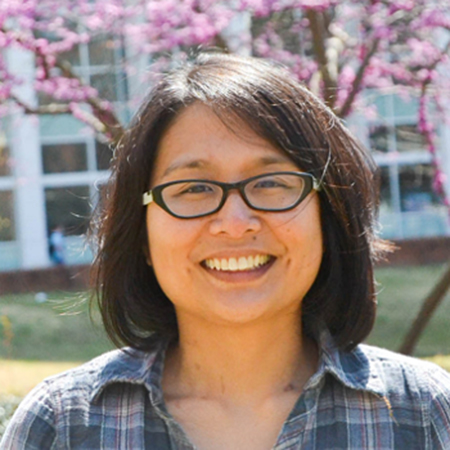
Ariane Peralta
Ariane Peralta is an Associate Professor of Biology at East Carolina University located in eastern North Carolina, USA. Ariane attended the University of Illinois at Urbana-Champaign to earn a BS degree in Biology and Chemistry and MS and PhD degrees in Ecology, Evolution, and Conservation Biology.
Ariane's dissertation examined how hydrologic changes during wetland restoration efforts affected microbial community structure and nitrogen cycling functions related to enhancing water quality. Then, Ariane moved on to a postdoc at the Kellogg Biological Station at Michigan State University and the Department of Biology at Indiana University. During this time, Ariane was awarded a Postdoctoral Fellowship from the United States Department of Agriculture National Institute of Food and Agriculture to study the consequence of long-term cropping diversity on soil microbial community structure and disease suppressive function in soils.
Since 2013, the Peralta Lab at East Carolina University has been examining how climate and human-induced environmental changes modify nutrient and water cycles to influence environmental microbiomes. The research team uses laboratory- and field-based approaches to study how climate and land use changes influence microbial community structure and functions associated with regulating air quality, water quality, and human, animal, and plant health. The Peralta Lab also conducts interdisciplinary microbiome research and collaborates with economists, engineers, geologists, and anthropologists to understand how ecological systems interact with human systems to better predict how microbial communities will respond to environmental changes.
Let's go back to the beginning — could you paint a picture of your childhood?
I was born in the Philippines in Manila, and we emigrated to the US after I turned one year old, settling in Northwest Indiana, outside Chicago. I grew up in a multigenerational household with my grandfather, aunts, uncles, and cousins — I'm an only child, but I never felt like one. My mother, Iris Legaspi Peralta, was a family doctor who took care of the entire community and never turned a patient away, even when they couldn't pay. She passed away before I got to high school, but watching her use her "science brain" to help people shaped how I've approached my own career ever since. Education was an expectation in my family — my great-grandmother was a teacher and my grandmother a pharmacist — so I always knew a career in STEM was possible for me.
At the University of Illinois at Urbana-Champaign, I found my way into a research-focused biology major, but I didn't discover ecology until a guest lecturer described manipulating carbon dioxide concentrations across whole forests to study climate change — I was totally engrossed, and that curiosity eventually led me to a soil ecology lab under Dr. Michelle Wander. For years I balanced science with music, playing electric bass in an indie rock band called The Beauty Shop, touring the UK and the Midwest between classes. It taught me the same do-it-yourself mentality that ended up serving me as a scientist: nobody's going to advocate for you but you.
What does your research mean for the future?
My PhD, at the same university, examined the microbial ecology of wetland restoration — how microbes in restored wetlands carry out water-quality functions like denitrification, and whether restored wetland communities ever really return to their natural state. After a postdoc at Michigan State's Kellogg Biological Station studying how cropping diversity affects soil microbial communities, I joined East Carolina University in 2014, where the Peralta Lab now studies how storm surges, sea-level rise, and nutrient pollution affect wetlands' ability to store carbon — work that matters enormously for climate change mitigation in a hurricane-prone region. We've also partnered with economists and engineers to model contamination risk in rural groundwater wells, since private well water in the US often goes untested for years at a time.
Nearly half of my students are the first in their family to attend college, and mentoring them is some of the most meaningful work I do. I know firsthand that this field hasn't always offered equal opportunity to women of color — I've had to push harder to be funded and recognized than my male counterparts. My advice to young Filipina scientists: don't be shy about advocating for yourself, and build a network of peers and mentors early. There's plenty of work to go around, and building each other up is our superpower.